

Source and Influence
Influences
The major architectural influences that shaped the idea of Nüwa: The Martian City. Based on the creations of Enki Bilal, the film "The Fifth Element" and "Metropolis".
Enki Bilal's work gives a dark and poetic nuance to the project, guiding the creation of a Martian metropolis that is both technological and human.
Who is Enki Bilal?
Enes Bilal was born on 7 October 1951 in Belgrade, Yugoslavia, two years after his sister Enisa. Their father, Muhamed "Hamo" Bilal, originally from Ljubuški (a village in Bosnia and Herzegovina, then part of Yugoslavia), was a Bosnian tailor and a non-practising Muslim, while their mother, Ana, was a Czech born in Karlovy Vary (then in Czechoslovakia). The family lived in Belgrade at 16 Tadeusz Kościuszko Street, in the Dorćol district. "Enki" is the affectionate diminutive of "Enes" used within the family, and later became his pen name as an author.
During Enes's childhood, his father refused to join the Communist Party, despite having been one of Tito's companions in the resistance; he sought asylum in France, where he had completed his tailoring training in 1936. His wife and their two children hurriedly joined him in Paris in 1961. In 1967, the Bilals were naturalised as French citizens.
Source : wikipedia.org

The Fifth Element
The dynamic and futuristic aesthetic of The Fifth Element inspires the design of a lively and positive Martian city, merging organic and technological elements.
In 1914, in a temple in Egypt, an Italian archaeologist describes to his young English-speaking assistant his understanding of a fresco engraved on a wall of the building. According to him, it would be a battle plan opposing on one side absolute Evil, whose coming is permitted by a planetary alignment that occurs every five thousand years, and on the other Good, whose weapon consists of four elements, surrounding a humanoid-shaped being, a fifth element, placed in the center. The temple priest, who surprises the discovery, tries to poison the two archaeologists to hide what they discover, but his attempt fails.
A huge alien spaceship then lands near the temple, belonging to tall aliens, fully harnessed in metal. Before the stunned archaeologists, they open a secret room located just behind the explanatory fresco and repatriate in their spacecraft the heavy metal statue (where the fifth element is located) and the four triangular stones that were there. The guardian priest, who is the terrestrial contact of the aliens, receives as explanation of their actions that they sense a war coming on Earth. They therefore consider it necessary to put these relics in safety with them. Finally, they specify to the priest that they will bring them back in three centuries, when they will be necessary when Evil returns, and give him the key to the secret room.
More than three hundred years later, in 2263, a spherical mass appeared near the Solar System in an indeterminate manner. The rocky celestial body without atmosphere is inert, immobile, and is not subject to any rotation or gravitational force. A combat spacecraft approaches and wants to destroy this anomaly by firing its most powerful missiles. The weapons are swallowed by this object which has only grown larger, until it destroys the ship and all its occupants.
At this time, the guardian priest of the Temple is a human named Vito Cornelius, an "expert in astro-phenomena". He is present in New York in the council room where military decisions are made in agreement with the President of the Federated Territories. Everyone in this room has watched live the dramatic end of the combat vessel.
The priest holds a grimoire in his hands and uses it to explain to the head of state the existence of the five elements. The relics are in possession of the alien ethnic group called Mondo-Shawans, presented as allies of the confederation. Cornelius informs the President of the scheduled arrival of this cosmic anomaly, which is none other than absolute Evil, whose goal is to make all life disappear in the Universe. The head of state listens attentively, because the way the combat spacecraft could be disintegrated inexplicably incites him to believe it. He then gives permission to enter the territories to a Mondo-Shawan vessel that has just arrived at the border of the Solar System. But the craft is attacked by warring vessels and the craft crashes on a moon.
Source : wikipedia.org | YouTube
Metropolis

The imposing and monumental architecture of Metropolis serves as inspiration for the design of important structures in Nüwa, which must combine utility and visual impact.
Metropolis is a German science fiction film directed by Fritz Lang, released in 1927.
A silent black and white film, it oscillates between expressionism and new objectivity. Adapted from the original novel by Thea von Harbou, the screenplay is co-written by her and Fritz Lang, married at the time. Brigitte Helm, Gustav Fröhlich, Alfred Abel and Rudolf Klein-Rogge are among the leading roles. The film is produced at Babelsberg studios by UFA (Universum-Film AG).
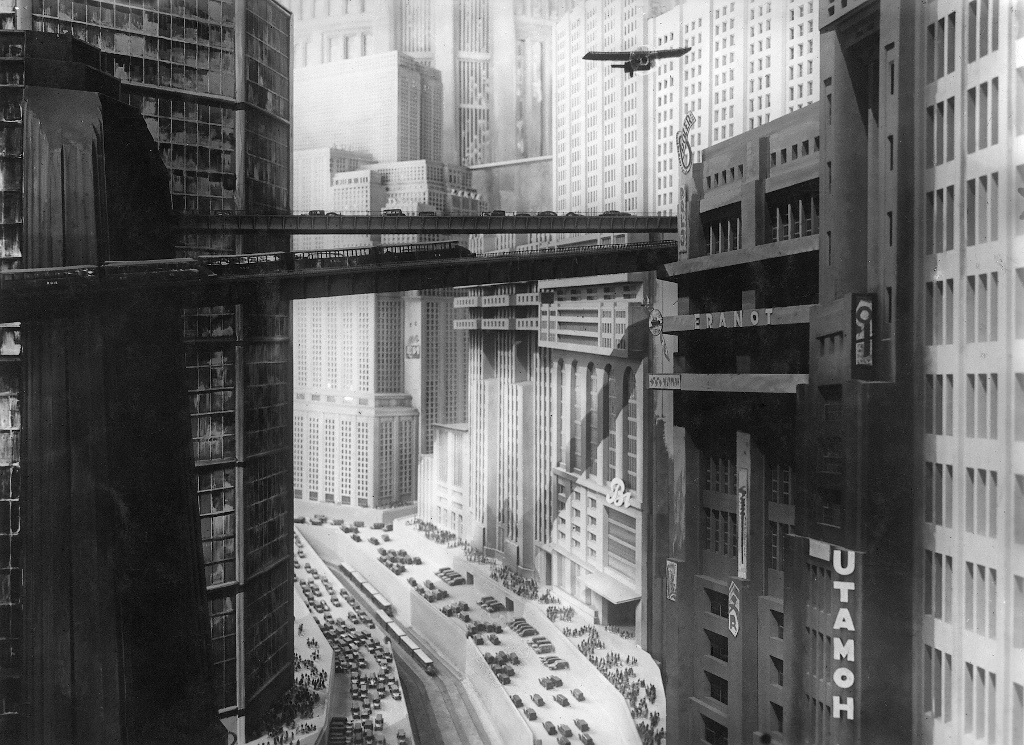

A critical and commercial failure upon its release while being, at the time, the most expensive film in cinema history, it is quickly truncated. It is gradually rehabilitated during the second half of the 20th century, to the point of achieving the status of major masterpiece of cinema history, as evidenced by its multiple influences to this day, particularly in popular culture. Restored several times, it became in 2001 the first film registered on the UNESCO Memory of the World International Register.
Source : wikipedia.org | Complete Film